About JASSA
Summary of JASSA
Activities of JASSA
Japan Staffing Services Association (JASSA) is the industry organization of the government-approved temporary work agencies. We aim to meet the expectations of temporary agency workers and client companies that use temporary agency workers, and contribute to society through the staffing service. We support all member companies in achieving compliance and proper business operation, and provide temporary agency workers with information, seminars, and e-learning for their career development.
Summary
| Name | Japan Staffing Services Association (JASSA) |
|---|---|
| Foundation | 1986.12.1 |
| Number of Members | 809 ( 2024.4.1 ) |
| Address | Nipponseimei-Shinbashi BLDG. 2F, 1-18-16 Shinbashi, Minato-Ku, Tokyo 105-0004 Japan |
Board members
| President | Kenichiro Kawasaki | Adecco Ltd. | Country President and Chairman |
|---|---|---|---|
| Vice-President | Koji Sakamoto | STAFFSERVICE HOLDINGS CO., LTD. | President & CEO |
| Vice-President | Hiroshi Ohara | Big Ability Co.,Ltd. | President |
| Board member | Masaru Anzai | Anzai Law Firm | Lawyer |
| Board member | Itsuro Igarashi | Tokio Marine & Nichido Career Service Co.,Ltd. | President & Chief Exective Officer |
| Board member | Masahiro Ikeda | ManpowerGroup Co., Ltd. | Representative Director & President |
| Board member | Akemi Inomata | Toyowork Co., Ltd. | Vice President Director |
| Board member | Yuichi Sumi | WILL GROUP, INC. | President |
| Board member | Kazunari Kimura | PERSOL TEMPSTAFF CO., LTD. | President and Representative Director |
| Board member | Satoshi Saruya | Randstad Japan | President and COO |
| Board member | Hideharu Tsubota | Japan Chamber of Commerce and Industry | Advisor |
| Board member | Kenji Akiyama | CAREER PLANNING Co., Ltd. | President |
| Board member | Shintaro Nakao | Pasona Inc. | President and COO |
| Board member | Ichirou Masumura | b-style holdings Inc. | Chairman and Director |
| Auditor | Hideharu Yoshida | PERSOL TEMPSTAFF CO., LTD. | General manager |
| Auditor | Takeo Okazeri | Takai Okazeri Law Offices | Office Manager |
(2024.04.01)
Development of JASSA
| 1984.7 | Formed the Japan Office Service Association with 8 companies |
| 1994.1 | Joined Ciett* (La Confederation internationale des entreprises de travail temporaire) JASSA has been participating its annual World Employment Conference every year since 1994. |
| 1995.7 | Joined the Japan Federation of Economic Organizations (currently, Japan Business Federation) |
| 2002.4 | Organized the Annual World Employment Conference <Ciett* 2002 Tokyo Conference> |
| 2002.5 | Established the Health Insurance Society For Temporary Agency Workers <Haken Kenpo> |
| 2010.5 | Signed joint statement with the Japanese Trade Union Confederation, Rengo |
| 2012.7 | Established the Japan Association of Human Resource Services Industry with 4 human resource services organizations |
* Ciett…Ciett changed its name to "World Employment Confederation" as of September 21, 2016
Scale of members' businesses
Employment share of temporary agency workers
Member approx.590,000 workers/Total approx. 1,340,000 workers
Member approx.590,000 workers/Total approx. 1,340,000 workers
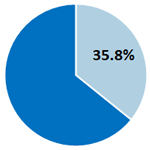
* [Reference] "Report on temporary agency work industry; current conditions as of June 1, 2018", published by the Ministry of Health, Labor and Welfare
Sales share of temporary agency work industry
Member approx. 2,293.1 billion yen/Total approx. 6,381.6 billion yen
Member approx. 2,293.1 billion yen/Total approx. 6,381.6 billion yen
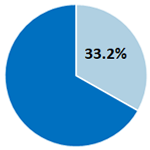
* [Reference] "Aggregated results of 2018 business report of temporary agencies", published by the Ministry of Health, Labor and Welfare